The Cost of a Disappearing Road
What I Spent (and Lost) Self-Publishing My First Book
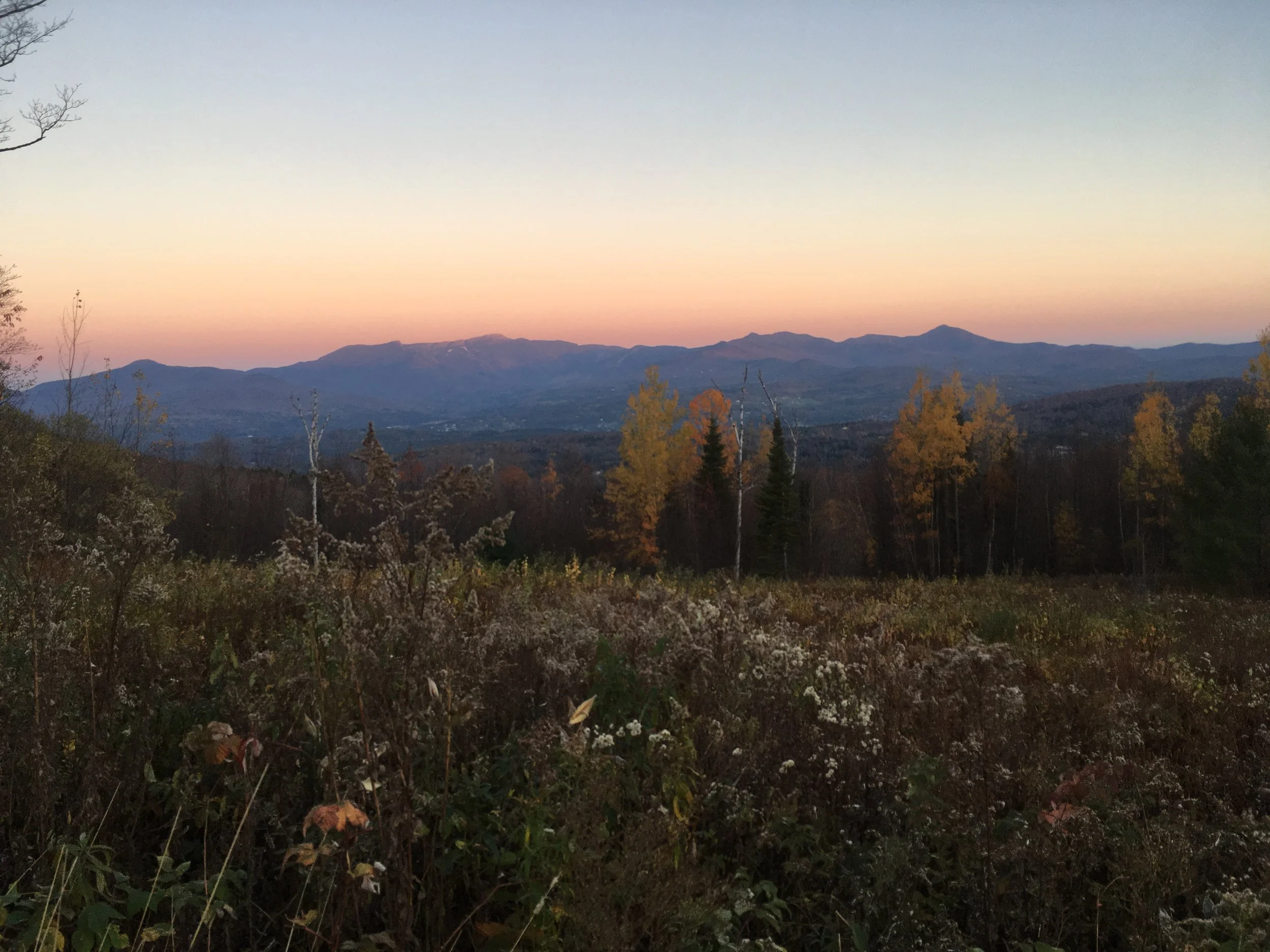
My last frosty Vermont sunrise hike before driving away from a well established photography career and deeply rooted friendships unsure of when I would return. Photo by Jennifer Langille, October 28, 2017.
In late 2016, I hit a professional wall with my photography career. I began seriously looking into what it might be like to hit pause and pursue a personal project. At that time, I had been working with a breast cancer research organization. Through them, I met a young woman diagnosed with a terminal form of the disease. Spending the day photographing her changed my world view.
While there was more to this story and other underlying factors at play, I knew it was time to shake things up. I wanted to imagine a different way forward as a professional photographer. At that time, countless Instagram and YouTube accounts were leading the way, romanticizing full-time life on the road—traveling and sharing stories one beautiful post at a time. I looked at my Jeep, my dog, and my camera and wondered, “Could I do that, too?”
Because a large portion of my income came from covering weddings in and around New England—which are booked at least a year in advance—I was committed to another year of doing more of the same. Except, I started doing it differently. [PHOTO]
I began viewing my Jeep as a mobile studio. I prepped it for a day of assignments, and if the weather allowed, I brought my dog along so I didn't have to rush home to let him out.
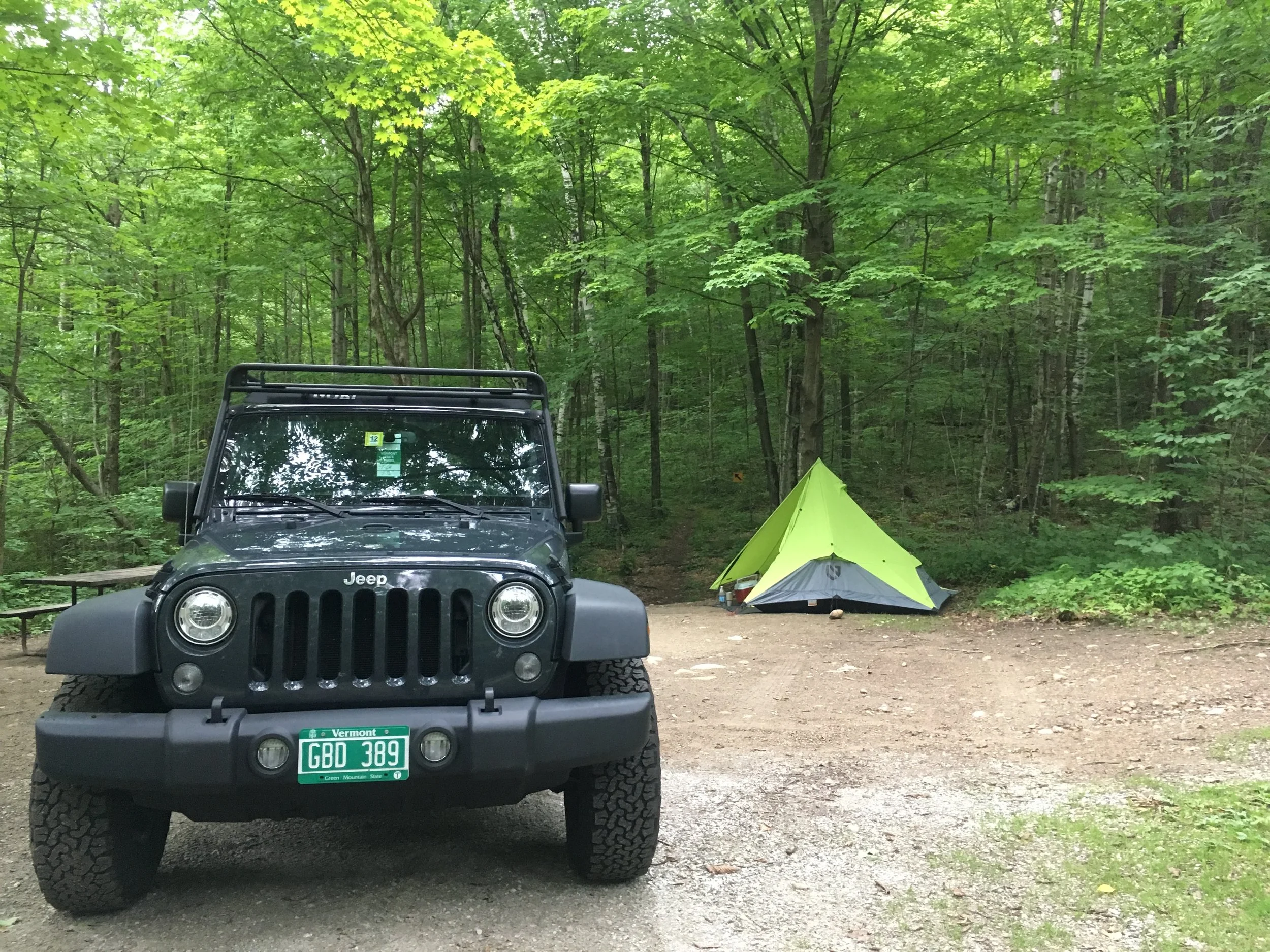
Camp set, time to go photograph a wedding and come “home” to this little green pyramid of a tent at the end of my night! Photo by Jennifer Langille 2017
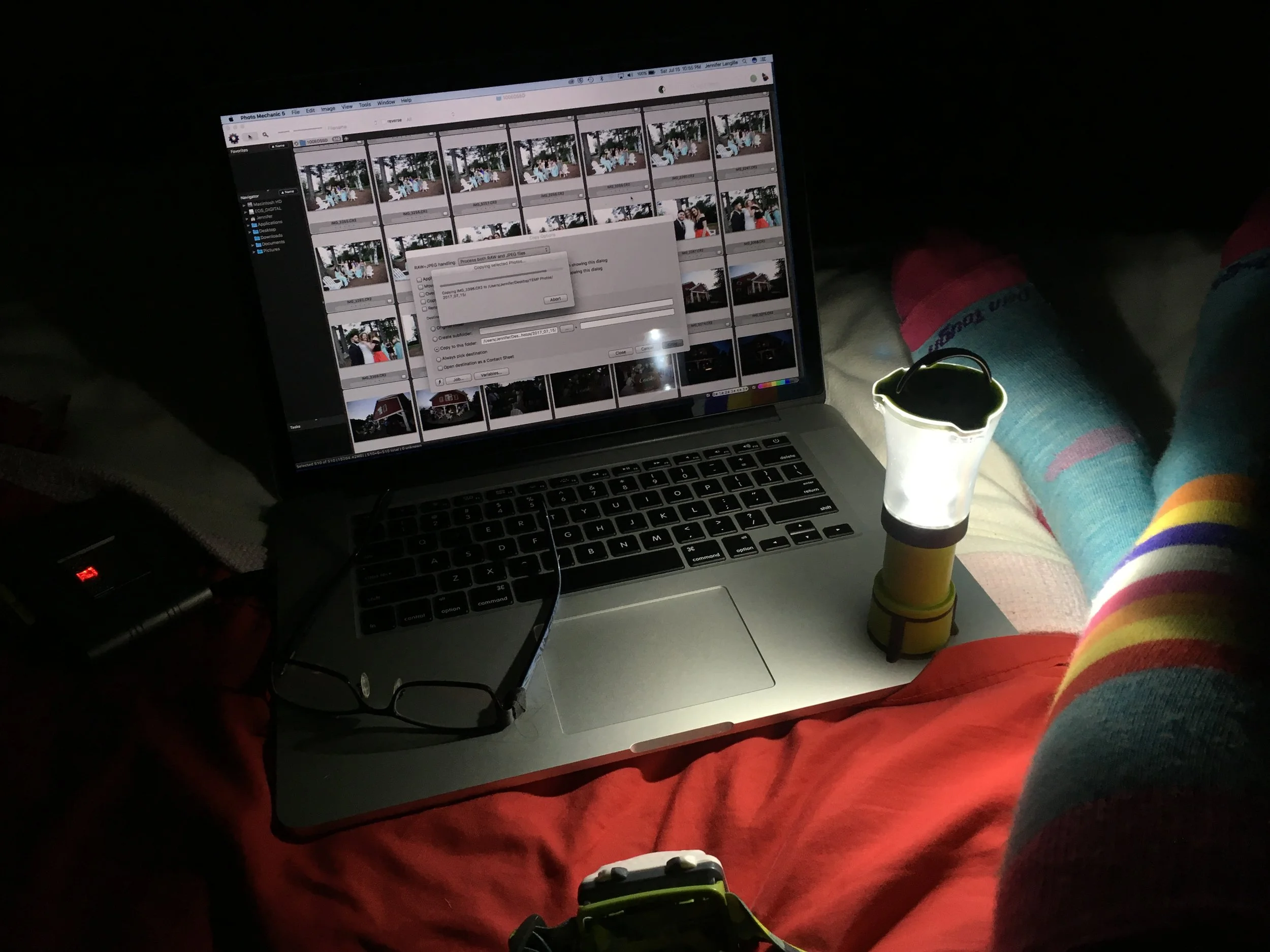
Wedding was a success, but before I can curl up into the sleeping back I must first back up all the day’s photography. Photo by Jennifer Langille 2017.
For longer gigs, like a wedding weekend where my dog stayed with friends, I packed up the Jeep as though I was going car camping. I stayed at campgrounds close to the venue with access to a shower (a must after a long day of photographing a summer wedding). This allowed me to dial in my exact needs and workflow. I really loved it, especially being able to get a full night’s rest before the long drive home.
2017 was a long year energy-depleting work filled with a few life-altering events that shifted my timeline.
By early autumn, I made the decision that changed my life forever. I would crash-course my way into what some call Overlanding—otherwise known as vehicle-supported travel, or essentially, long-term car camping. I sold off everything I no longer needed, and everything else went into storage for the foreseeable future.
Here is where the story began to take a turn. All this time, I wore a permanent pair of rose-tinted glasses, fueled by images of other people’s lives on the road as portrayed by social media. Soon enough, I would learn just how much people kept to themselves about the harsh realities of choosing the unpaved road. And little did I know, those harsh backcountry realities were nothing compared to the nightmare of trying to self-publish that story years later.
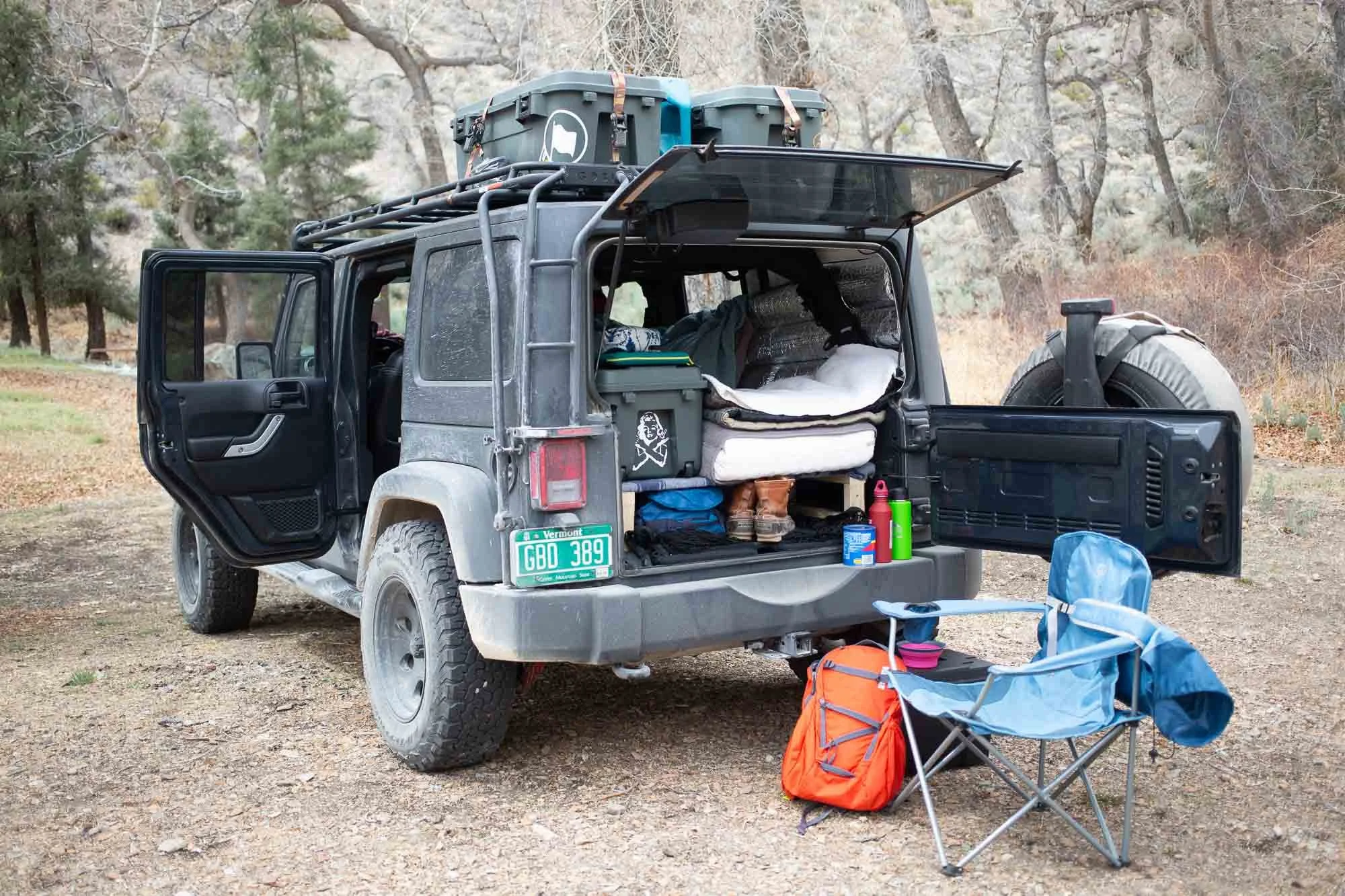
The reality of living out of a Jeep was far dustier than expected and entailed very little head room. Camping outside Round Mountain, Nevada at Peavine Creek Campground. Photo by Jennifer Langille (2018).
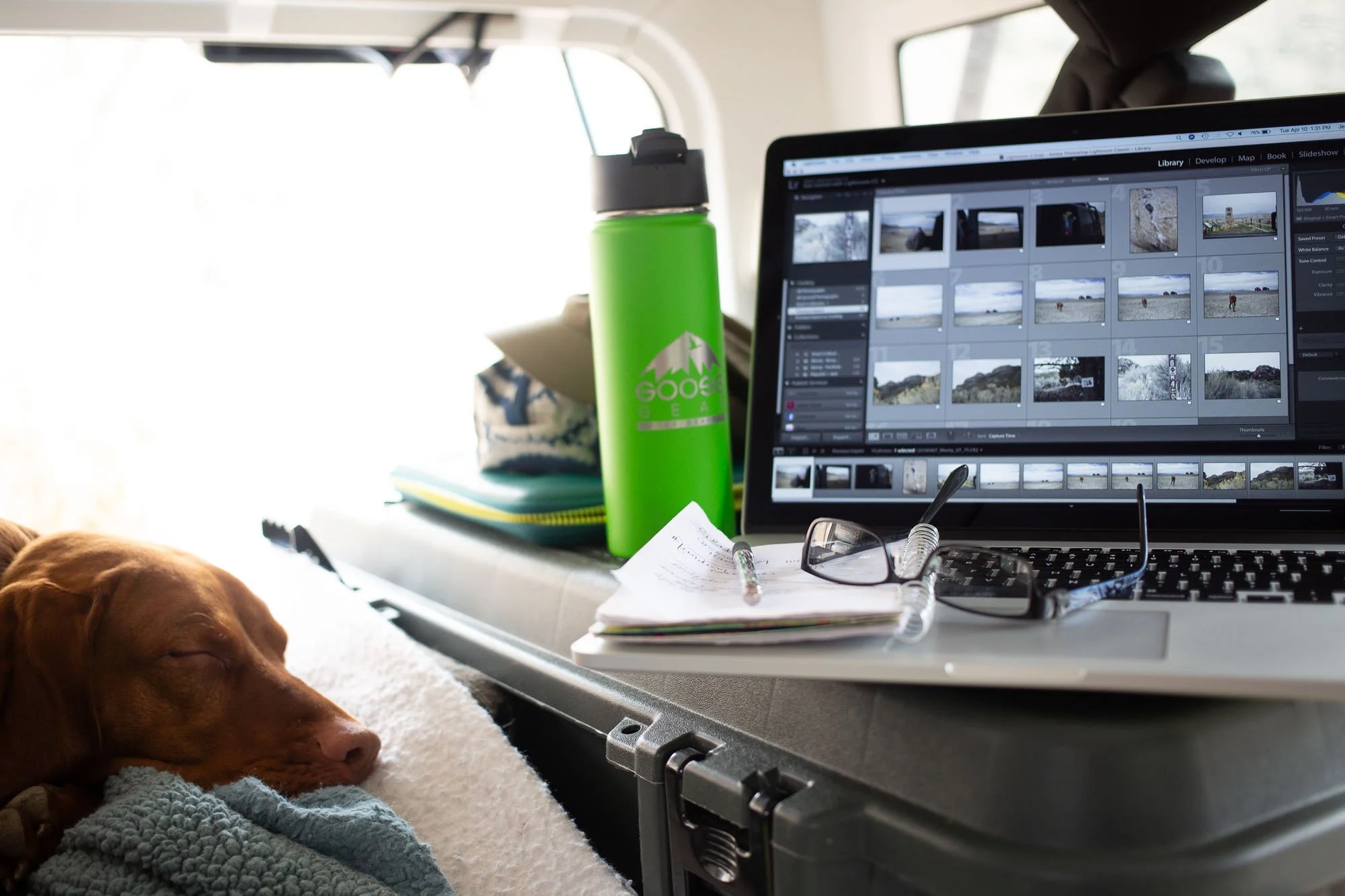
It was not all bad, as my dog was by my side and the “office views” were special, but I did hit my head on the ceiling quite frequently. Camping outside Round Mountain, Nevada at Peavine Creek Campground. Photo by Jennifer Langille (2018).
With the Jeep fully transformed into a mobile studio, my dog and I officially left our Vermont home and friends in December of 2017. I had a loose plan to collect stories of cancer’s impact on the lives of those willing to share, all while navigating the challenging landscapes of the American countryside. What could go wrong? Quite a bit, in fact.
I did not set out to write a book, though my father had planted the initial seed that this adventure could become one. My original idea was simply to post these stories to my social media channels and website. However, that version of the project never came to be.
Right from the get-go, I discovered that funding a personal project would become a story in itself. My wish was for the focus to remain entirely on the brave people facing a cancer diagnosis. But I quickly learned a hard truth: while people care deeply about the impact of this disease, they aren't necessarily lining up to sponsor or fund a solo project about it. It was a dark foreshadowing of what my future self would continue to endure.
The realization that this needed to be a book didn't take hold for another five months. It happened when I was introduced to an oncology nurse who specialized in palliative care. Her words cemented the idea of pursuing a book—one that blended my raw story of travel with the profound stories of the people I met.
But for those first five months, I really had no idea what I was doing out there in the wilds of America. Most of the time I was in pure survival mode, scared and unsure of where I was going to sleep. I never posted pictures or stories to social media because I didn't want anyone to know my exact location, even after I had moved on. Instead, I only communicated with prospective sponsors, current funders, and potential story leads. My days were filled with tracking down local libraries for Wi-Fi, drafting funding proposals, and writing email updates to the small community acting as my primary fiscal supporters (I had a GoFundMe for this endeavor).
During all of this, I never stopped to think about what I would truly need to write a manuscript. I didn't realize how invaluable daily logs—not emotional journal entries, but hard data like mileage, waypoints, weather, road conditions, what I saw, and specific people met—would have been helpful. While I kept a daily journal, tracking those technical details would have made writing the book infinitely easier later on. They are the exact details that add atmospheric magic to a scene or help you remember the smaller yet impactful happenings. I took thousands of pictures on my iPhone and dropped a lot of pins on Google Maps, which later helped me re-trace my travels, but knowing what I know now, I would approach the “data collection” of a journey like this quite differently.
Even after I committed to writing the book, I still didn't know what I was doing. Furthermore, deciding to write a book didn't change the immediate reality of living out of a Jeep with a dog without a reliable source of income. I had left my well-paying photography clients behind in the Northeast to pursue an underfunded project. I was constantly scrambling just to afford the gas to keep moving, or to eventually get back home. Yet, where was home? I had technically given it all up.
The pile of problems was mounting. Mount Everest was emerging right ahead of me, and I didn't even know yet that I would have to summit it just to arrive where I am today.
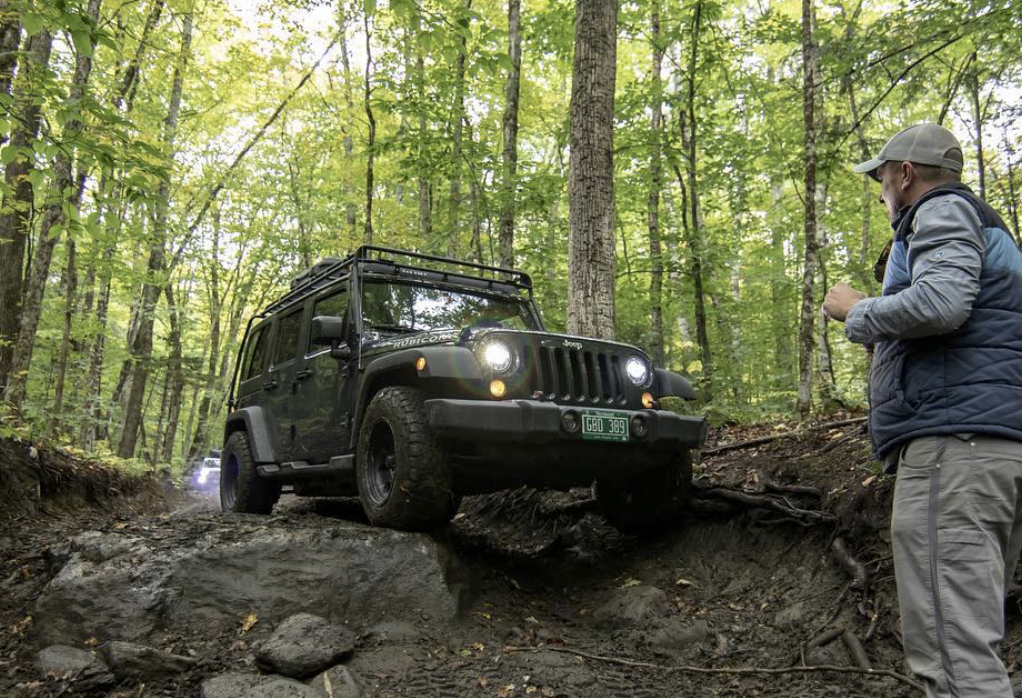
Jason of Mountain State Overland guiding me through a tricky rocky section of trail in Southern Vermont. What a treat it was to have help. A memory I hold dear. A friendly reminder of how with a little help we can truly tackle hard scary things. Photo by Ben Knight / Mountain State Overland (2018).
Looking back now, nearly eight years after I first left, it still feels a little shocking that I made it back east. But I did. And it was finally time to take the idea of writing my first book seriously. While I had previously made a living as a writer, my past work was always short and punchy—usually fifteen hundred words or less. The average nonfiction manuscript runs between 60,000 and 90,000 words. To tackle that, I needed a place to hole up for a while. Since I had relinquished my home in Vermont and returned with barely a penny to my name, I had to find a unique solution.
One frequently recommended route for aspiring authors is to apply for a residency program. These programs offer a safe haven where you can put in the long hours of actual writing. In exchange, you usually contribute your time to cover the cost of hosting you—whether that means teaching your craft, helping with daily operations, or assisting around the property.
There are incredible residency programs for writers all over the world, but they all come with one major caveat: virtually none of them welcome four-legged companions. My dog would have had to find his own "residency" with someone else, which was a complete non-negotiable for me. He was an integral part of the story, and I intended to write this book with him right by my side.
This meant I had to essentially create my own residency program. Luckily for me, my best friend from college owned a farm with an empty studio apartment, and she was in dire need of an extra set of hands.
So began the next leg of this quest to become a first-time author. But as I was about to find out, it is infinitely easier to shovel actual cow poop than it is to write and self-publish a book.
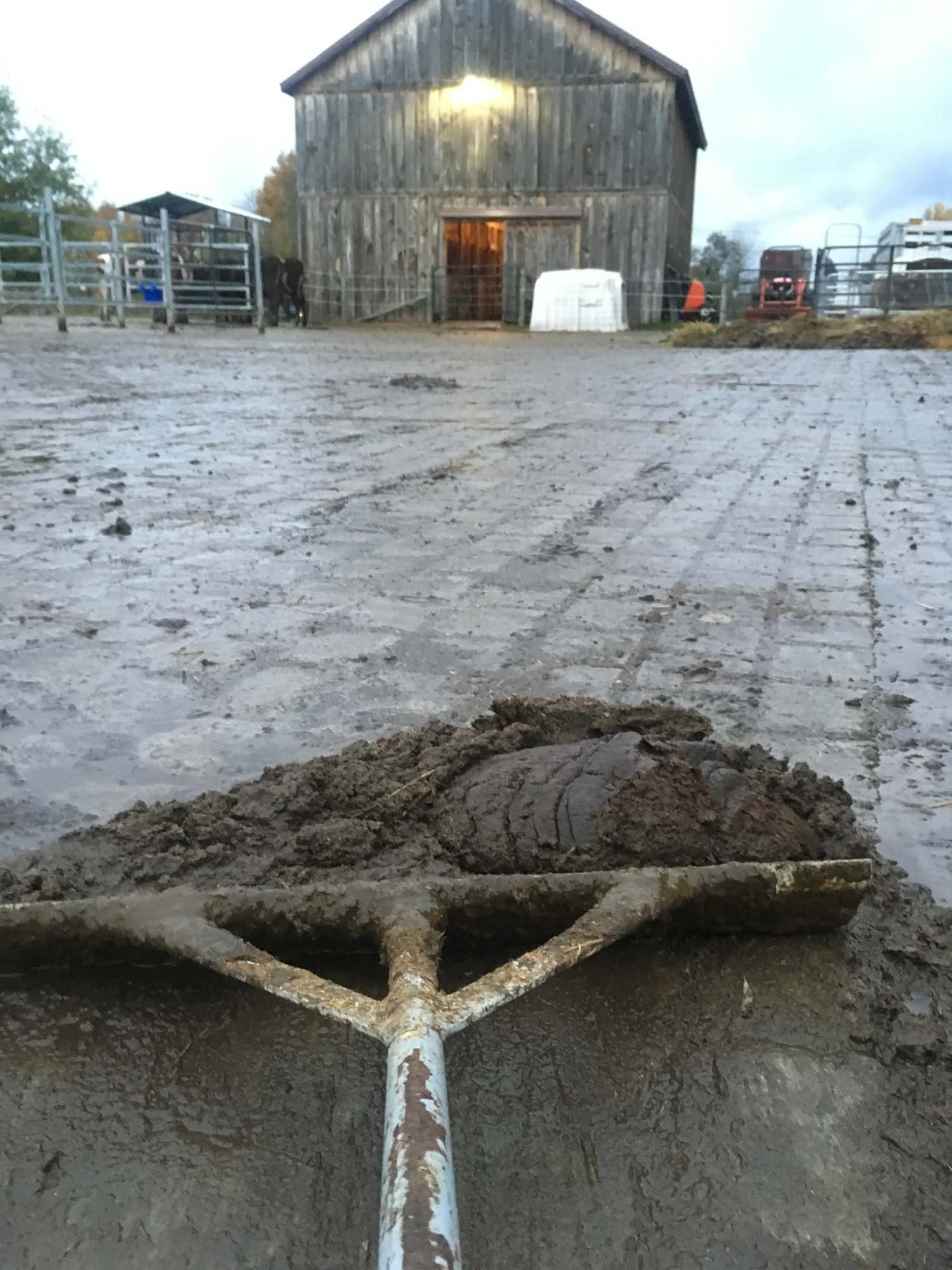
The most un-beautiful picture of me scraping poop during farm chores sometime in November of 2018. A sometimes satisfying task and sometimes not so much.
Settling into farm life was far harder than I expected. It was immensely more physical than I anticipated; the general population grossly misunderstands just how hard farmers work. Before this, I was part of that general population.
Yet, the twice daily bouts of manual labor actually helped me internally process the chaotic undertaking of my cross-country travels. However, I was so physically exhausted that it was months before I could finally embark on stringing words together. My new reality required waking up at 4:00 AM to write for an hour or two in the dark before joining everyone for morning chores in the barn. Afterward, I used the middle of the day to scramble for whatever paid freelance work I could find, before evening chores began. Then, I collapsed into bed just to start the cycle all over again the following day.
A note to anyone with a romantic idea of farming — there are no days “off” for farmers.
Just as I was finally settling into the rhythm of the farm, securing steady work, and cobbling together a complete first manuscript (which, looking back, was entirely awful), COVID-19 hit.
Little did I know, I was only at the absolute base of my personal Mount Everest. It was about to get a whole lot harder.
The first feedback from early readers suggested there was a great story buried in the pages, but it was structurally messy and completely unpublishable (as proven by the pile of book proposal rejections from traditional publishers). Prior to the pandemic, I had been carefully saving up to hire a professional editor. I was also taking every online course I could find covering book structure, editing, and publishing. I felt a crushing pressure to deliver a finished product. A great many people believed in this project and had provided direct financial support to help me get it across the finish line. I couldn't let them down.
Without the budget for a traditional editor, I threw myself into endless self-rewrite cycles with my new best friend—Grammarly (it’s no human editor but it can help an over-tired author who can’t afford the human). Eventually, I decided to take the leap into self-publishing. I thought I was finally approaching the summit. I chose a fairly well-known self-publishing service—which will remain nameless—and pulled the trigger. Proofs were ordered. Pre-orders were collected from my trusting community. Bulk copies were bought and paid for.
And then, the books never came.
The company went completely dark. Calls and emails went unanswered. When I consulted legal friends, they gave me the cold, hard truth: the money lost—just under $10,000 for the unprinted books alone, to say nothing of my years of time—was not a large enough sum to warrant the high costs of a legal battle. I had to swallow the loss during a period of life when I had no reliable income. My freelance work ended with the start of the pandemic and I took up painting watercolor pet portraits to keep progress moving forward.
Between the printer bailing and the subsequent global supply chain collapse which impacted the cost of paper (important factor to consider when producing a book), my dream of publishing When The Road Disappears was instantly placed on hold. I was completely broke and devastated. Furthermore, as this nightmare was all playing out, I suffered a severe adverse autoimmune response to the COVID-19 vaccine and developed Lupus over the coming years. Suddenly, I wasn't just fighting for my book—I was fighting for my health. Thankfully, the backers waiting for their copies turned out to be absolute saints. Because of their grace, and a fierce refusal on my part to let this story die on that farm, the road didn't end there. One way or another, we were going to see this through.
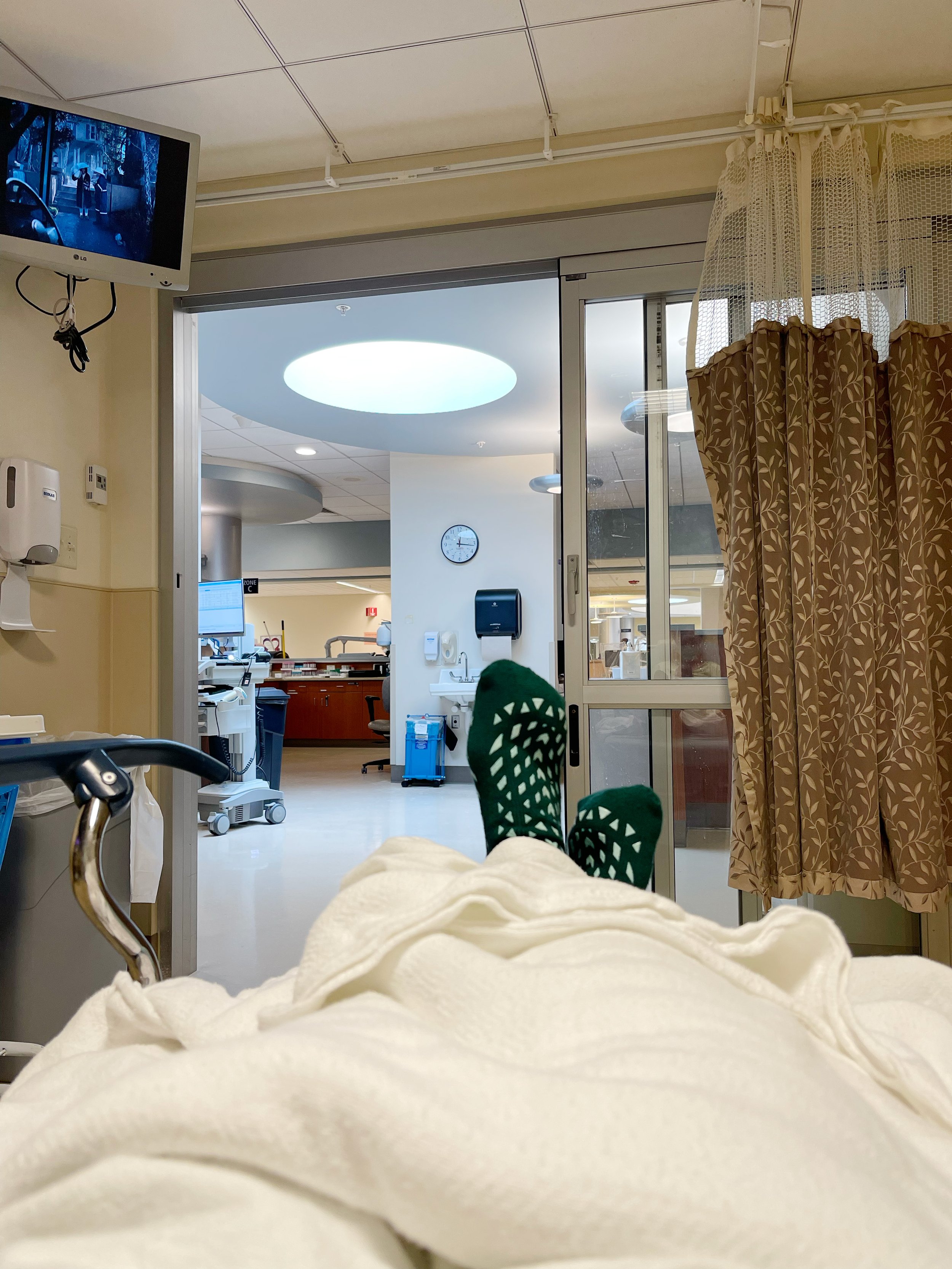
March 11, 2022, marked my first-ever overnight stay in an Emergency Room. It was the worst night of my life, but at least we determined I wasn't having a heart attack. Sadly, it was just the start of a long road filled with endless doctors' appointments, labs, and surgical procedures.
Despite what I just shared, if I am being completely honest, I was at a total breaking point. It took nearly three exhausting years just to figure out how Lupus was impacting my body, and I had to accept the humbling truth that my physical life would never look the way it did when I set out on this grand adventure. As if the decision to embark on a self-supported personal project wasn't a big enough pivot, my own body had forced an even bigger one. The theme of my book began to mirror my reality; I was navigating my own disappearing roads, forced onto a journey I never asked to take.
I put the manuscript aside.
I considered refunding every single pre-order, too. But finding sustainable work on the heels of the pandemic with a newly struggling body was incredibly difficult.
Then, I hit absolute rock bottom. I had to put down my dog—my constant companion, my co-pilot from the day we left Vermont until the day we landed on the farm. Saying goodbye to my boy broke me into a million more pieces than an unfulfilled $10,000 book order ever could. In an instant, every road truly disappeared. I simply didn't care about climbing mountains anymore.
For a long time, and to this day, I feel his absence. But just before the pandemic, I had adopted his niece. As the months rolled on, she took up her post by my side. She sat with me through the flares, the grief, and the quiet. Watching her, and remembering the incredible resilience of the cancer patients I had interviewed on the road, a small, stubborn thought took hold: I am living the exact story of uncertainty that I set out to write about. I couldn't let the road end in a dead end.
While it felt like it took forever, freelance work eventually filled back in, and a new professional journey as a film producer took shape. Stepping into film shined a bright light on my deep love for an impactful story. In turn, it reminded me that I had a powerful story of my own still waiting to be told.
In the spring of 2025, I gave the manuscript another brutal rewrite. A professional editor was still financially out of the cards, and I finally decided it would just be what it would be. I am here to say that I will absolutely prioritize a professional human editor before I embark on my next book (which I do plan to do), but for this book, I had to be enough with some gentle assistance from Grammarly for catching every time I typed “out” instead of “our.”
Fortunately, the self-publishing space had evolved, and a lot had changed since my first attempt. There were [are] better offerings for Indie authors—specifically from IngramSpark, the exact printer I had originally wanted to work with but couldn't afford years prior.
As if someone flipped a switch, the mechanics of the project began to feel easier, even fun! I don't mean the rewriting itself, but from layout to proofing it was far more enjoyable this time around. One of my distinct advantages in this solo venture was my background in graphic design. It granted me complete creative control, from how the words displayed on the page to the overall layout of the book. I spent hours painstakingly measuring the margins of all my favorite books on my shelf, determined to make this look as professional as any traditional house publication.
Somewhere between grappling with giving up and getting back into the thick of it, the why behind setting out on this self-imposed quest bubbled back to the surface. Sure, I didn't want to let down everyone who had supported this project, but eventually, I came to realize that I didn't want to let myself down, either.
I dug in. If I wasn't working my day job, I was working on this book. I spent hours dialing in the words, the layout, the illustrations, the cover designs, and the fonts. A dozen printed proofs later—a process that IngramSpark made incredibly affordable and easy (I promise this post is not sponsored by them)—I took a deep breath and once again placed a bulk order for books.
This time, they actually showed up.
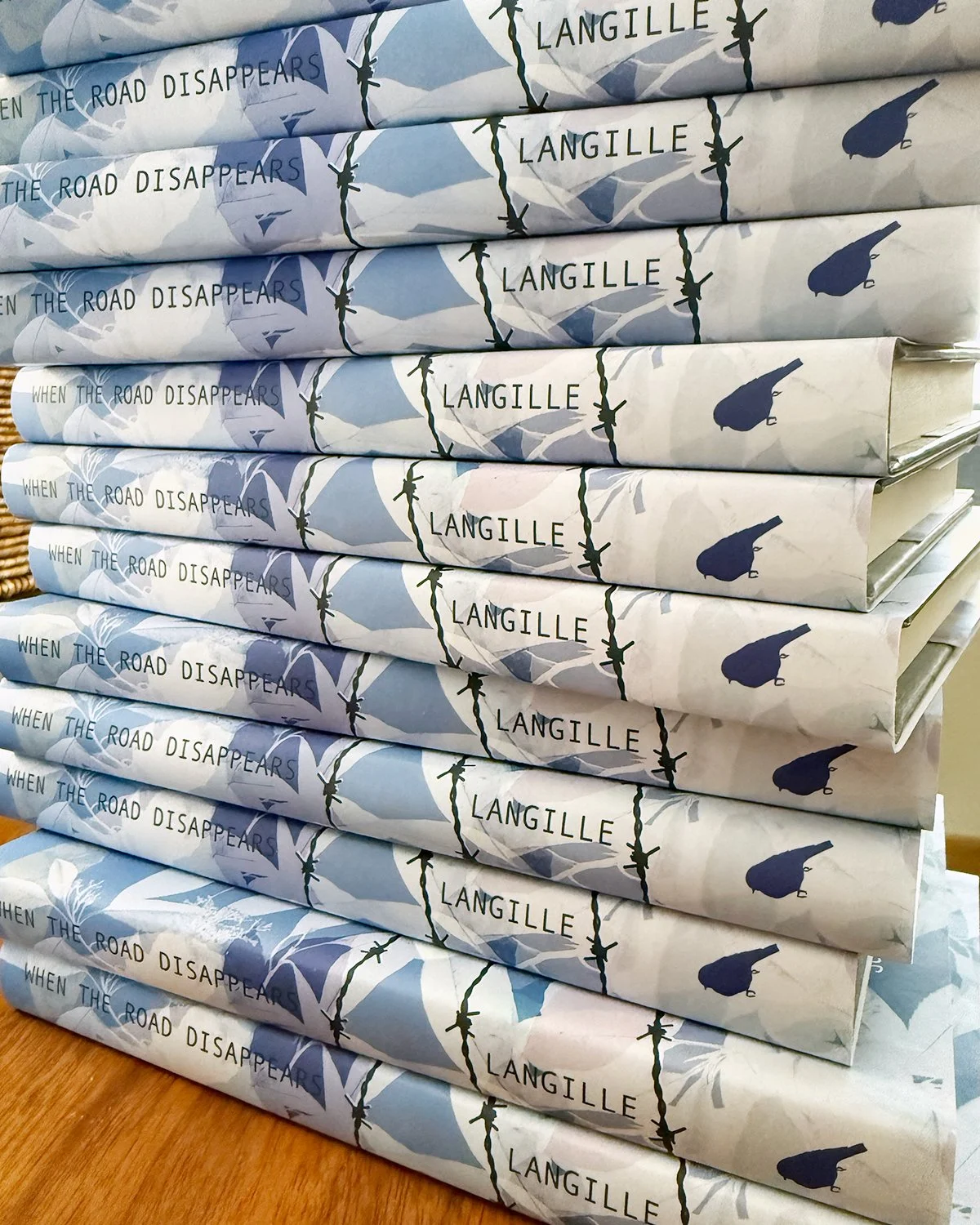
I was genuinely unsure if I would ever see this day!
Now, if you recall, I was already out nearly $10,000 from the first printing disaster. That meant I was paying entirely out of pocket for every single copy I owed my original backers. Thankfully, the cost of print-on-demand technology had come down significantly, and I learned how to make strategic adjustments to the book’s physical specifications to lower production costs. There is a hidden fee tied to every choice you make: the trim size of the book, the paper weight, the page count, and the cover finish. It is a massive laundry list unique to every project.
Reprinting, shipping, and packaging materials ultimately added another $6,000 out of my own pocket, to say nothing of years of unpaid time. But looking back, that $16,000 total deficit was simply the cost of learning—and a reflection of the unpredictable, disappearing roads that life so often presents. In truth, it could have been far more costly.
I can almost hear someone asking, “You published your book, Jenn! Can’t you make that all back in book sales?” Highly unlikely as an otherwise unknown Indie storyteller who has a tiny platform of support. Maybe one day! Though I would have to sell anywhere between 1,100 to 1600 copies to break even. People do not write and produce books to become financially successful. They write them because they believe in their place in our world.
When The Road Disappears is a relatively easy read, an engaging story, but it is also far from being a clean manuscript. The story structure could use some work, too. But I am very proud of it and more importantly, delighted for readers to meet the people I met while on this journey. I hope those who grace its pages show me some grace as a writer, but come away feeling inspired to carry on when the road of life disappears.
Additionally, being an “open book” and sharing what I’ve learned to help others publish their stories has brought immense healing to my own difficult journey. Working with aspiring storytellers and supporting them on their quest brings me a lot of joy. Furthermore, it helps me see how my willingness to persevere when things get tough is a superpower worth passing on to others.
